What You Need to Build a Simple E-Commerce Website in Kenya (2026 Guide)
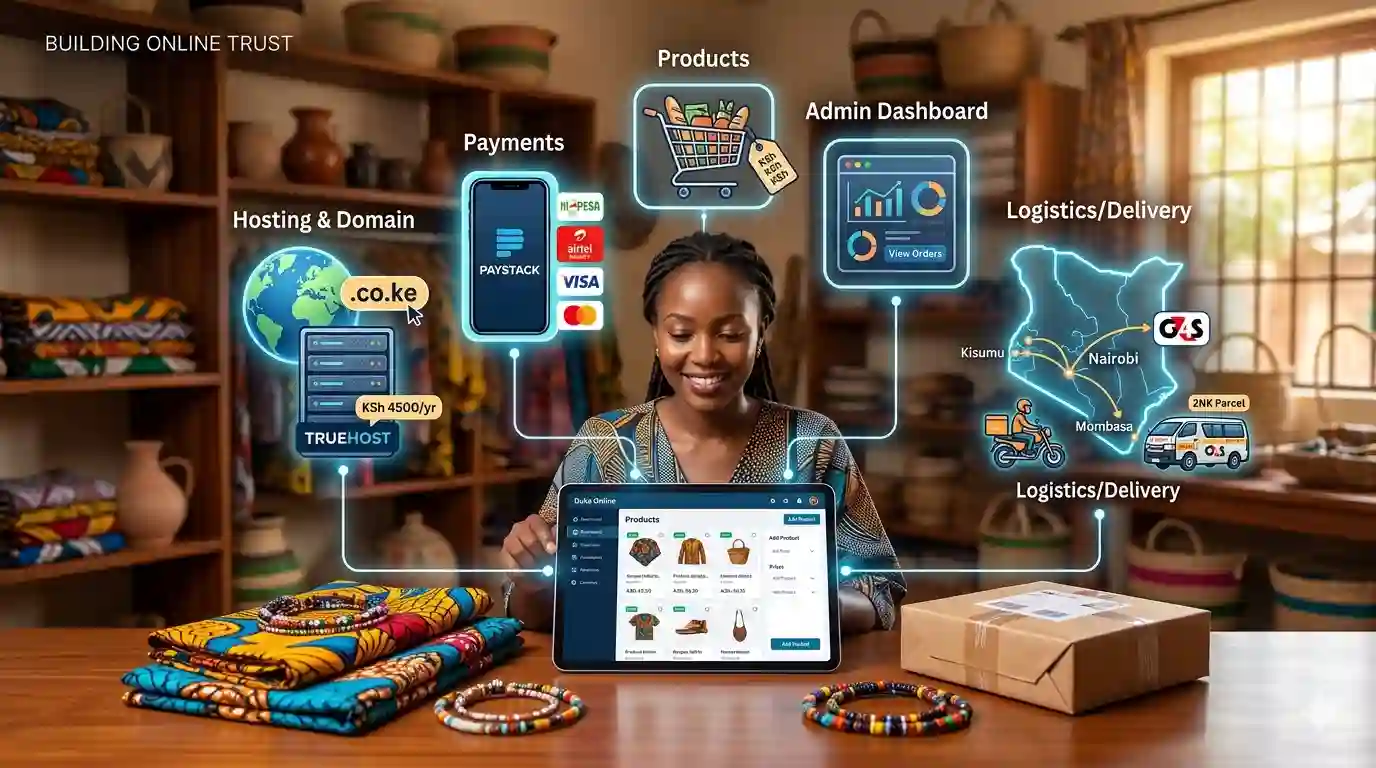
Selling online in Kenya has never been more realistic for ordinary businesses. Whether you are selling clothes from Gikomba, electronics in Luthuli Avenue, handmade jewellery from your home studio in Rongai, or fresh farm produce from Limuru — a proper e-commerce website can open your business to customers across the country without you needing a physical shop in every town.
But here is where many Kenyan entrepreneurs get stuck. They do not know where to start. What platform do you use? How do customers pay? How do you handle delivery? How much does it all cost? These are fair questions, and this guide answers every single one of them — practically, honestly, and specifically for the Kenyan market in 2026.
Ready to skip straight to getting your e-commerce site built? Talk to our team at ProKenyan → — we build ready-made and custom e-commerce websites for Kenyan businesses, complete with Paystack integration, admin dashboard, and delivery setup. Contact us to see samples.
First Things First — What Does an E-Commerce Website Actually Need?
Before we get into the tools and costs, let us be clear about what a functional Kenyan e-commerce website actually consists of. It is not just a pretty website with pictures of products. A proper online shop has several working parts that must all be in place before you start taking orders:
- A product catalogue where customers can browse, search, and view what you are selling
- A shopping cart and checkout flow that feels smooth and trustworthy
- A payment system that accepts M-Pesa, cards, and other popular methods
- An admin panel where you manage products, view orders, and track inventory
- A delivery and fulfilment system so products actually reach customers
- Security that protects both your business and your customers
- A mobile-friendly design — because most of your customers are shopping on their phones
Every single item on that list matters. Miss one and your online shop will either fail to launch, fail to convert, or fail to retain customers. Let us go through each one in detail.
Payments — The Most Important Decision You Will Make
Here is the truth about e-commerce in Kenya: if your payment system does not work, nothing else matters. You can have the most beautiful product catalogue in the country, but if a customer gets to checkout and cannot pay easily and securely, they will abandon their cart and never come back.
The payment gateway we recommend without hesitation for Kenyan e-commerce in 2026 is Paystack.
Why Paystack Is the Best Choice for Kenyan E-Commerce
Paystack entered the Kenyan market and quickly became the preferred payment gateway for online businesses — and for very good reason. Here is what makes it stand out:
- Free account creation — signing up is completely free. There is no monthly subscription fee, no setup fee, no minimum balance requirement. You create an account, verify your business, and you are ready to start accepting payments
- Low, transparent transaction fees — Paystack charges a straightforward percentage per successful transaction, with no hidden fees. For local transactions, the cost is competitive and significantly lower than some older payment processors in the Kenyan market
- M-Pesa integration — customers can pay directly via M-Pesa STK Push from the checkout page. The payment prompt is sent straight to their phone. They enter their M-Pesa PIN and the payment is confirmed in seconds — no PAYBILL numbers to memorise, no manual confirmation needed
- Airtel Money support — Airtel Money users are not left out. Paystack handles Airtel Money payments in the same seamless flow
- Debit and credit cards — Visa, Mastercard, and Verve cards are all supported. Customers with bank cards can checkout just as smoothly as M-Pesa users
- Multi-currency support — Paystack handles Kenyan Shillings (KES), US Dollars (USD), Euros (EUR), British Pounds (GBP), and several other currencies. If you are selling to diaspora customers or international buyers, your checkout can reflect their preferred currency
- Bank transfers — customers can also pay via direct bank transfer for higher-value orders where they may prefer not to use a card or mobile money
- Instant settlement — funds are settled into your registered bank account on a regular schedule, with clear transaction records you can reconcile easily
- Developer-friendly API — for custom-built websites, Paystack has a clean, well-documented API that integrates smoothly with Laravel, Next.js, WordPress WooCommerce, and virtually any modern web framework
In short, Paystack lets your customer in Kisumu pay via M-Pesa, your customer in Nairobi pay via their Equity Visa card, and your customer in the diaspora pay in dollars — all through the same checkout, all landing in your account. That is the kind of flexibility that grows an online business in Kenya.
Hosting — Where Your Website Lives
Your website needs to be hosted on a server somewhere — a computer that is connected to the internet 24 hours a day so your site is always accessible. The quality of your hosting directly affects your website's speed, reliability, and security. Cheap, overcrowded hosting means a slow site that goes down at inconvenient moments. Good hosting means your site loads fast and stays up.
For Kenyan e-commerce websites, we recommend starting with a reliable local hosting provider — and one of the most solid options in Kenya right now is Truehost.
Truehost — Reliable Kenyan Hosting Starting from KSh 4,500/Year
Truehost is a Kenyan hosting company that has built a strong reputation for reliability, local support, and genuinely affordable pricing. For a small to medium e-commerce website, their hosting plans start at around KSh 4,500 per year — that is less than KSh 400 per month to keep your online shop live and running around the clock.
What you get with a Truehost plan:
- Fast SSD storage that keeps your website loading quickly
- Free SSL certificate — the padlock in the browser bar that tells customers your site is secure, and that Google requires for any site accepting payments
- One-click WordPress installation — if you are building on WooCommerce, you are up in minutes
- Email hosting — so you can have professional email addresses like [email protected]
- Local Kenyan customer support that understands the Kenyan market
- Scalable plans — as your business grows and traffic increases, you can upgrade your hosting without switching providers
You can get started with Truehost here — their plans are straightforward, the setup is beginner-friendly, and for a starting e-commerce site, their entry-level plan is more than sufficient.
As your shop grows and you need more performance — faster load times, more concurrent users, better database handling — upgrading to a VPS (Virtual Private Server) plan gives you dedicated resources and significantly better performance for a busier store.
Your Admin Dashboard — Running Your Shop Day to Day
One of the most important but least talked-about parts of an e-commerce website is the admin panel — the backend interface where you, as the shop owner, manage everything. A good admin dashboard is the difference between running your online shop efficiently and spending your evenings drowning in confusion.
Here is what your admin panel must allow you to do without needing a developer every time:
Product Management
- Add new products with images, descriptions, pricing, and stock quantities in minutes
- Edit existing products — update prices, change images, adjust descriptions — immediately and easily
- Organise products into categories so customers can browse logically — Dresses, Electronics, Fresh Produce, whatever your shop sells
- Set product variants — sizes, colours, weights — so one product listing handles all the options cleanly
- Mark products as out of stock automatically when inventory reaches zero, preventing orders you cannot fulfil
- Feature specific products on your homepage for promotions and seasonal highlights
Order Management
- View every new order immediately when it is placed — customer name, phone number, delivery address, items ordered, and payment confirmation
- Update order status — Pending, Processing, Shipped, Delivered, Cancelled — so customers always know where their order is
- Search and filter orders by date, status, or customer to find specific orders quickly
- Export order data to Excel or CSV for accounting, reporting, or reconciliation
- Send customers automated SMS or email updates when their order status changes
Customer and Sales Reporting
- See your total sales, revenue, and order volumes at a glance
- Identify your best-selling products and your slowest-moving inventory
- View customer purchase history to understand buying patterns and inform restocking decisions
- Track which payment methods your customers prefer — M-Pesa versus card, for example — so you can optimise your checkout
A well-built admin panel means you are in control of your shop at all times. You do not need to call your developer every time you want to add a new product or check your orders for the day. That independence is essential for running an online business efficiently.
Delivery and Fulfilment — The Part That Builds Customer Trust
Here is something many first-time e-commerce business owners in Kenya underestimate: delivery is where trust is built or permanently destroyed. A customer can love your website, trust your Paystack checkout, and order confidently — but if their package arrives late, arrives damaged, or does not arrive at all, they will never order again and they will tell everyone they know.
Getting your delivery and fulfilment system right from the start is not optional. It is the foundation of customer retention and word-of-mouth growth in the Kenyan market.
Professional Courier Services for High-Value and Nationwide Delivery
For businesses shipping higher-value goods or needing nationwide reach with tracking and insurance, established courier companies provide the reliability and accountability that customers trust:
- G4S Courier Services — one of the most established courier operations in Kenya with nationwide reach, parcel tracking, and delivery confirmation. For valuable products where both you and your customer need proof of delivery and accountability, G4S provides that peace of mind
- Wells Fargo Courier Kenya — a long-standing Kenyan courier company with a strong reputation for reliable delivery across Nairobi and major towns. Their tracking system allows both the business and the customer to follow a parcel through every stage of delivery
- DHL Kenya — for businesses selling to international customers or shipping high-value goods, DHL provides global reach with full tracking, insurance options, and customs handling
Matatu and Bus Parcel Delivery — The Kenyan Last-Mile Solution
Here is something that makes the Kenyan delivery landscape genuinely unique — and incredibly practical. Most upcountry and inter-town deliveries in Kenya are done through the matatu and bus parcel delivery networks that have operated on Kenyan roads for decades. These systems are affordable, fast, and deeply trusted by Kenyan consumers who have been using them long before e-commerce existed.
- 2NK Parcel Delivery — serving numerous routes across Kenya, 2NK has built a reliable same-day and next-day parcel delivery system leveraging the bus and matatu networks on major routes. For businesses shipping to towns along their routes, 2NK is fast, affordable, and familiar to customers
- MTN Parcel Delivery — another established network using the public transport system to move parcels reliably across Kenya's major routes at costs that are significantly lower than formal courier companies
- Easy Coach, Modern Coast, and other bus lines — many long-distance bus companies offer parcel delivery services where you drop off at their Nairobi terminal and the recipient collects at the destination town terminal. Fast, cheap, and widely used
For many Kenyan e-commerce businesses, the practical delivery strategy is a hybrid: use matatu and bus parcels for domestic inter-town delivery (cheaper, faster on many routes), and use established couriers like G4S or Wells Fargo for Nairobi CBD and estate deliveries, high-value items, or when a customer specifically requests tracked door-to-door delivery.
Building Delivery Trust Into Your Website
Beyond choosing the right delivery partners, your website needs to communicate delivery clearly to build customer confidence before they even place an order:
- Display your delivery partners' logos on your website — customers recognise G4S and Wells Fargo and immediately feel more confident
- Show clear delivery timelines and costs on your product pages and at checkout — no surprises at the last step
- Offer order tracking where possible, even if it is a manual update system via SMS or WhatsApp
- Have a clearly written returns and exchange policy — customers who know they can return something are more willing to order in the first place
- Collect and display customer reviews specifically mentioning delivery experience — social proof around delivery is enormously persuasive for first-time buyers
Security — Protecting Your Customers and Your Business
Customers in Kenya are increasingly savvy about online security, and rightly so. If your website looks untrustworthy — no padlock, no recognisable payment logos, no clear contact details — they will leave. Security is not just a technical concern; it is a conversion issue.
- SSL certificate (HTTPS) — absolutely non-negotiable. Every hosting plan worth considering includes a free SSL certificate. Without it, browsers display a "Not Secure" warning that will kill your conversion rate immediately
- Paystack's PCI-DSS compliance — Paystack is certified to the highest international standard for payment security. Customer card details never touch your server — they go directly through Paystack's secure infrastructure
- Regular backups — your hosting provider should be running daily backups of your website. Confirm this before you launch and know how to restore if something goes wrong
- Strong admin passwords and two-factor authentication — your admin panel is the keys to your shop. Protect it accordingly
- Privacy policy and terms of service pages — legally required if you are collecting customer data, and a genuine trust signal for customers who check before buying
How Much Does It All Cost to Get Started?
One of the most common questions we hear at ProKenyan is: "How much does it cost to start an online shop in Kenya?" The honest answer is: it depends on what you need. But here is a realistic breakdown for a simple, functional e-commerce website:
- Domain name (.co.ke) — approximately KSh 1,000 to KSh 1,500 per year
- Web hosting (Truehost entry plan) — from KSh 4,500 per year
- SSL certificate — free with most hosting plans including Truehost
- Paystack account — free to create, pay only per transaction
- Website development — this is where the range is widest. A basic DIY WooCommerce setup costs mainly your time. A professionally built custom e-commerce site from a team like ProKenyan includes custom design, Paystack integration, admin dashboard, mobile optimisation, and SEO setup
The recurring costs — hosting and domain — are genuinely low. The one-time investment in a properly built website is where the real decision lies, and it is worth doing correctly from the start rather than rebuilding six months later because the initial version was not fit for purpose.
Ready-Made vs Custom E-Commerce — Which Is Right for You?
At ProKenyan, we offer both approaches depending on what stage your business is at and what your goals are.
A ready-made e-commerce template gets you live faster and at a lower entry cost. The core functionality — product catalogue, Paystack checkout, admin panel, order management — is already built. We configure it for your business, add your branding, load your initial products, and hand it over ready to trade. This is ideal for businesses that want to test the online channel quickly before committing to a fully custom build.
A custom-built e-commerce website is built specifically around your business processes, your brand, and the features your specific shop needs. Custom filtering, subscription models, bulk ordering systems, loyalty points, multi-vendor marketplaces, integration with your existing accounting software — all of these are possible with a custom build. It takes longer and costs more, but it is yours completely, and it scales with your business.
Both options come with Paystack integration, mobile-first design, SEO structure, admin dashboard, and our ongoing support.
Want to see real examples? Contact the ProKenyan team → and ask to see our ready-made e-commerce samples. We will show you working demos of shops we have built for Kenyan businesses, walk you through the admin panel, and give you an honest quote for what your specific shop would cost to build. No pressure, no jargon — just a straight conversation about what works for your business.
The Bottom Line — Starting Your Online Shop in Kenya in 2026
The ingredients for a successful Kenyan e-commerce website are all available, affordable, and proven. Paystack handles your payments across M-Pesa, Airtel Money, cards, and multiple currencies. Truehost gives you reliable hosting for less than KSh 400 a month. Established couriers and the matatu parcel network handle your delivery nationwide. And a well-built admin panel puts you in complete control of your shop without needing a developer for every update.
The businesses selling online in Kenya right now are not necessarily the biggest or the most tech-savvy. They are the ones that made a decision, found the right partners, and took the first step. Every shop you see thriving online started exactly where you are now — with a product, a customer base, and a question about where to begin.
Now you have the answer. The next step is yours.
Get in touch with ProKenyan today → — tell us what you are selling, where you are based, and what you need. We will put together a clear plan, show you working samples, and get your online shop built and trading as quickly as possible.