7 Powerful Ways Kenyan Businesses Are Using AI to Work Smarter and Grow Faster
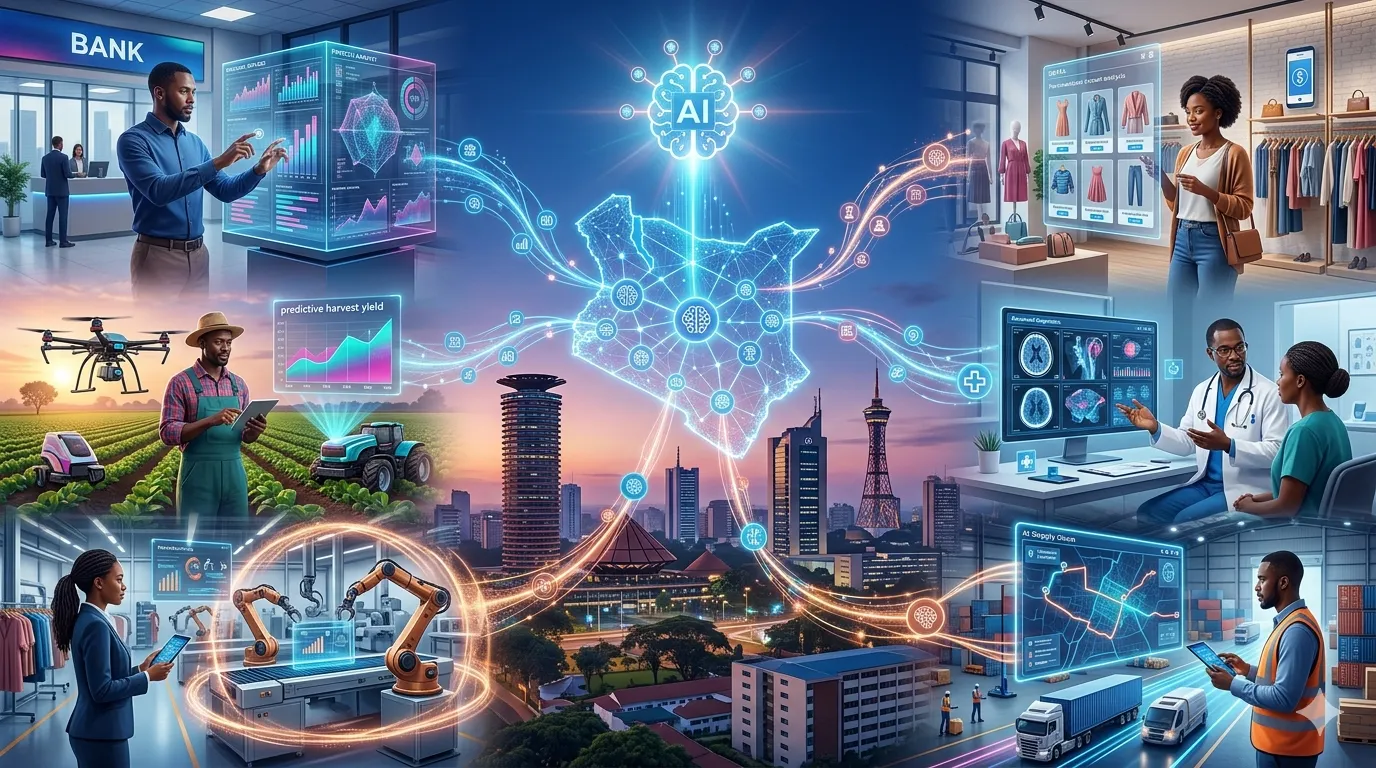
Artificial Intelligence is no longer something happening in Silicon Valley boardrooms or MIT research labs. It is happening right now, in Nairobi, Mombasa, Kisumu, and Nakuru — in small businesses, in startups, and in established companies that have decided they are not going to be left behind. Kenyan entrepreneurs are using AI tools today to write faster, market smarter, respond to customers instantly, and build websites that would have required a full agency team just three years ago.
And the best part? Most of these tools are affordable, accessible on a smartphone, and require zero technical background to get started with.
At ProKenyan, we work with businesses across Kenya to build digital systems that leverage modern technology — including AI. In this article, we break down seven practical, real-world ways you can start using AI in your business right now, and the tools that make each one possible.
1. Blogging and SEO Content Writing
Let us start with one of the highest-return uses of AI for any Kenyan business with an online presence — content creation. Every business website needs a steady stream of well-written, keyword-rich blog content to rank on Google. The problem is that writing takes time, and time is the one resource every business owner in Kenya is perpetually short of.
AI writing tools have completely changed this equation. Tools like Claude (by Anthropic), ChatGPT (by OpenAI), and Gemini (by Google) can help you draft a full, well-structured blog article in minutes — not hours. You give the tool a topic, some context about your business and audience, and a few key points you want covered. It produces a solid first draft. You read it, add your local knowledge and voice, adjust the examples to fit the Kenyan context, and publish.
What AI does particularly well for SEO content:
- Generating keyword-rich article outlines before you write a single word
- Writing meta titles and meta descriptions that are optimised for Google click-through rates
- Expanding thin content into comprehensive, in-depth articles that Google tends to rank higher
- Suggesting related topics and semantic keywords that strengthen the topical authority of your content
- Rewriting existing content that is underperforming — improving structure, readability, and keyword placement without starting from scratch
- Translating content into Kiswahili to reach a broader Kenyan audience and capture local-language search traffic
The important distinction to understand is this: AI is a writing assistant, not a replacement for your expertise. The tools do not know your specific clients, your local market nuances, or the particular challenges your industry faces in Kenya. Your job is to supply that context, review the output critically, and ensure every article genuinely serves your reader. Google's algorithms in 2026 are sophisticated enough to reward genuinely helpful content and filter out hollow, generic AI-generated filler — so the human layer of judgment remains essential.
Used correctly, AI can take a business from publishing one blog post every two months to publishing four per month — without hiring a content writer. That increased publishing frequency compounds into significantly more Google traffic over time.
2. Facebook and Social Media Post Creation
Social media is where most Kenyan businesses first show up online, and for good reason — Facebook alone has over 4 million users in Kenya, and Instagram and TikTok are growing rapidly among younger urban demographics. The challenge is that maintaining a consistent, engaging social media presence requires a constant flow of fresh content, captions, hashtags, and post ideas. For a business owner already wearing fifteen hats, this is the task that gets neglected first.
AI tools solve this problem elegantly. With the right prompt, you can generate a full month of Facebook post captions in under twenty minutes. You can ask for post ideas organised by theme — promotional posts, educational posts, behind-the-scenes content, customer testimonials, local event tie-ins. You can ask the AI to write in a specific tone — professional for a law firm, warm and conversational for a salon, energetic and bold for a fitness brand.
Practical ways to use AI for social media in your Kenyan business:
- Generate thirty days of post captions at the start of each month and schedule them using a tool like Buffer or Meta Business Suite
- Write punchy promotional captions for product launches, sales, and seasonal offers — Nairobi Fashion Week, back-to-school season, end of year
- Create educational carousel post scripts — "5 Things to Know Before Building Your Home in Kenya" — that position you as an expert in your field
- Draft responses to common comments and DMs so your team can reply faster and more consistently
- Repurpose long blog articles into five to ten bite-sized social media posts, extending the life of content you have already created
- Generate platform-specific variations — what works as a Facebook post needs adjustment for a LinkedIn article or a TikTok caption
Tools like Claude, Copy.ai, and Jasper are built specifically for marketing copy and produce social media content that feels natural and brand-appropriate when given the right instructions. The key is building a good system prompt — a paragraph describing your brand, your audience, your tone, and your typical content themes — and reusing it every time you generate content.
3. Image Generation for Marketing and Poster Creation
For years, one of the biggest pain points for Kenyan businesses in digital marketing was imagery. Professional photography is expensive. Stock photo libraries are dominated by Western faces and contexts that feel completely disconnected from the Kenyan market. And hiring a graphic designer for every promotional poster, social media graphic, and banner ad adds up fast.
AI image generation has fundamentally changed this. Tools like DALL·E 3 (integrated into ChatGPT Plus), Midjourney, Adobe Firefly, and Stable Diffusion can generate high-quality, commercially usable images from a text description in seconds. You type what you want. The AI produces it.
For Kenyan businesses, this opens up possibilities that simply did not exist before:
- Generate product lifestyle images without a photoshoot — "a young Kenyan woman using a laptop in a modern Nairobi coffee shop, natural light, professional"
- Create illustrated hero images for your website that reflect your brand aesthetic without paying a designer
- Produce featured images for every blog post — no more relying on generic stock photos of American office workers
- Generate marketing poster backgrounds, then layer your text and branding using Canva or Adobe Express
- Create social media graphics for every occasion — promotions, public holidays, new product announcements — at zero cost beyond your subscription
For poster creation specifically, the workflow that works best for most Kenyan businesses is a hybrid approach: use AI to generate the visual background or illustration, then bring it into Canva to add your logo, brand colours, promotional text, and contact details. This gives you the visual quality of a custom design without the timeline or cost of commissioning one from scratch.
Adobe Firefly deserves special mention here because it is trained exclusively on licensed content, meaning everything it generates is safe for commercial use without copyright concerns — an important consideration for any business using AI imagery in paid advertising or printed materials.
4. Business Automation — Customer Replies and Email Workflows
How much time does your team spend on repetitive communication every day? Answering the same WhatsApp enquiries about your prices, your opening hours, your delivery areas. Sending follow-up emails to customers who enquired but did not convert. Writing thank-you messages after a purchase. Sending appointment reminders. Chasing overdue invoices.
All of this is necessary. None of it requires a human being to think deeply about every single instance. And AI-powered automation tools can handle most of it — freeing your team to focus on conversations that actually require human judgment and relationship-building.
The automation stack that works for Kenyan businesses in 2026:
- Make (formerly Integromat) and Zapier — no-code automation platforms that connect your tools together. When a customer fills in your contact form, automatically add them to your CRM, send them a welcome email, and notify your sales team on WhatsApp — all without touching anything manually
- AI-powered email drafting — tools like Gmail's AI Smart Reply and Superhuman suggest complete email responses based on the incoming message context, reducing the time to respond to a customer from ten minutes to thirty seconds
- Automated follow-up sequences — using tools like Mailchimp or Brevo (formerly Sendinblue), you can set up email sequences that automatically nurture leads over days or weeks after they first enquire — educating them, answering objections, and guiding them toward a purchase decision without manual intervention
- WhatsApp Business API automation — automatic replies to common questions, order confirmations, shipping updates, and appointment reminders sent directly to your customers' WhatsApp, triggered by actions in your system
- Africa's Talking SMS automation — for Kenyan businesses needing to reach customers who may not have WhatsApp or reliable internet, Africa's Talking provides an API for automated SMS sending, delivery confirmations, and two-way SMS conversations
The goal of business automation is not to make your business feel robotic — it is to ensure that no customer falls through the cracks, every enquiry gets a prompt response, and your team's time is spent on high-value work rather than administrative repetition.
5. AI Chatbots for Customer Support
Your customers do not only have questions during business hours. They visit your website at 10pm, over the weekend, on public holidays. And when they have a question and cannot get an answer, they leave — often to a competitor whose website did provide the information they needed.
An AI chatbot on your website solves this problem completely. A well-configured chatbot can handle the majority of common customer enquiries automatically, around the clock, in a conversational and helpful way — escalating to a human team member only when the conversation requires genuine human judgment.
What AI chatbots can handle for a Kenyan business:
- Answering questions about your services, pricing, and availability instantly
- Collecting lead information — name, phone number, specific requirements — and passing it to your sales team
- Helping customers navigate your website to find what they are looking for
- Providing order status updates for e-commerce businesses by integrating with your order management system
- Booking appointments or scheduling calls by integrating with your calendar system
- Handling basic complaints and routing complex issues to the right department with full context already captured
The tools making this accessible in 2026 range from simple to sophisticated. Tidio and Crisp are affordable, easy-to-set-up live chat tools with built-in AI capabilities — perfect for small to medium businesses. Intercom and Zendesk AI offer enterprise-grade chatbot capabilities for larger operations. For businesses that want a fully custom chatbot trained specifically on their own product knowledge, pricing, and FAQs, tools like CustomGPT or a custom integration with the OpenAI API or Anthropic Claude API allow you to build a chatbot that knows your business inside out.
For Kenyan businesses, the WhatsApp channel is particularly important. A chatbot that operates within WhatsApp — responding automatically to messages sent to your business WhatsApp number — meets your customers on the platform they already use and trust, rather than requiring them to interact with an unfamiliar chat widget on your website.
6. Website Creation with AI Assistance
Building a professional website used to require either significant technical skills or a meaningful budget to hire a developer. In 2026, AI has dramatically lowered both barriers — though it is important to be clear about what AI can realistically do versus where professional development still adds irreplaceable value.
On the accessible end of the spectrum, tools like Wix ADI, Squarespace AI, and Framer AI can generate a complete website from a text description of your business in minutes. You describe your business, your target audience, and the pages you need — and the AI produces a working website with a design, placeholder content, and a logical structure. You then customise the content, colours, and images to match your brand.
For businesses that need more power and flexibility, AI is increasingly embedded into professional development workflows:
- GitHub Copilot and Cursor — AI coding assistants that write code alongside developers in real time, dramatically accelerating the development of custom Laravel, Next.js, and React applications. A feature that might take a developer two hours to build from scratch can be drafted in twenty minutes with AI assistance
- AI-generated content for every page — using Claude or ChatGPT to draft the copy for your About page, Services pages, and FAQs before the developer builds the site, so the website launches with real content rather than "Lorem ipsum" placeholders
- AI-assisted SEO setup — generating optimised meta titles, descriptions, and heading structures for every page of a new website before launch
- Design generation with v0 by Vercel — a tool that generates complete React UI components from a text description, which developers can then integrate directly into a Next.js or React application
The honest truth for Kenyan businesses is that AI website builders are a reasonable starting point for very small businesses that need an online presence immediately and have a minimal budget. But for businesses that are serious about SEO, performance, custom functionality, and a design that genuinely reflects their brand — professional development with AI-assisted tools produces a substantially better result than an AI builder alone. The two are not in competition; they serve different needs at different stages of a business.
7. AI for Business Strategy, Research, and Decision-Making
The seventh way Kenyan businesses are using AI is perhaps the least visible but potentially the most valuable — using AI as a strategic thinking partner and research assistant.
Running a business in Kenya in 2026 means navigating a fast-changing landscape — new tax regulations from KRA, evolving consumer behaviour, new competitors, shifting social media algorithms, and global economic pressures that filter down into the local market. Staying on top of all of this while simultaneously running day-to-day operations is genuinely difficult.
AI tools are remarkably effective research and analysis partners:
- Market research — ask an AI to summarise the competitive landscape in your industry, identify gaps in the market, or analyse what your competitors are doing well based on their public presence
- Business plan drafting — for entrepreneurs seeking funding, AI can help structure a compelling business plan, financial projections narrative, and executive summary far faster than starting with a blank page
- Pricing strategy — describe your cost structure and competitive environment, and ask AI to help you think through pricing models and their trade-offs
- Customer persona development — describe your existing customers and AI can help you build detailed personas that sharpen your marketing messages and product decisions
- Contract and proposal drafting — AI can draft service agreements, project proposals, and client-facing documents that you then review and adapt, saving hours of writing time
- Data analysis — tools like ChatGPT with Code Interpreter or Claude can analyse spreadsheets, sales data, and survey results and produce clear summaries of patterns and insights that would take hours to extract manually
The Bottom Line: AI Is a Tool, Not a Magic Wand
Let us be direct about something. AI will not save a bad business, replace genuine expertise, or substitute for the relationships and trust that Kenyan business is built on. The businesses getting the most value from AI in 2026 are not the ones handing everything over to the machine — they are the ones using AI to amplify what they are already good at.
Use AI to write faster, not to think less. Use it to generate images quicker, not to lose your brand identity. Use it to automate the repetitive, so your team has more energy for the meaningful. That is the formula that is working for Kenyan businesses right now — and the results, for those who have committed to it, are genuinely significant.
The businesses that thrive in the next five years will not be the ones with the biggest teams or the largest budgets. They will be the ones that learned to work smarter — and in 2026, working smarter means understanding how to use AI as a genuine business tool.
Want to integrate AI into your business website or digital strategy? At ProKenyan, we build websites and digital systems that are designed from the ground up to work with modern tools — AI chatbots, automation integrations, SEO-optimised content structures, and performance-first architectures that give your business a real competitive edge online.
Talk to our team today → — let us show you what is possible for your business specifically.